
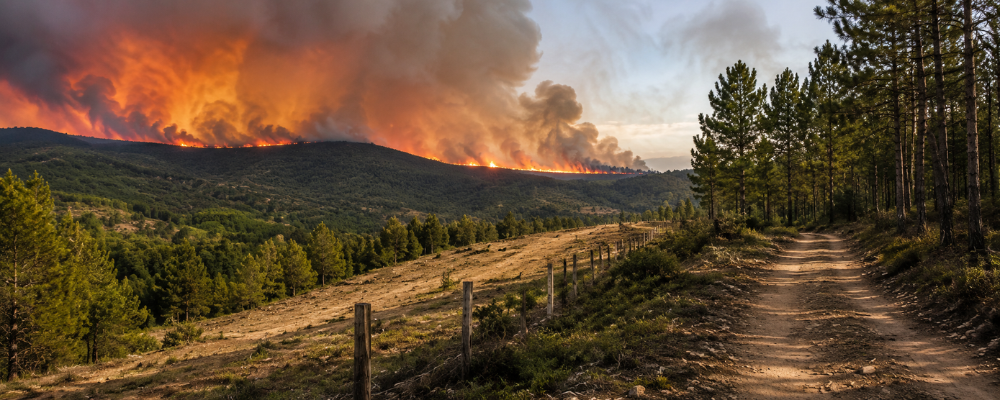
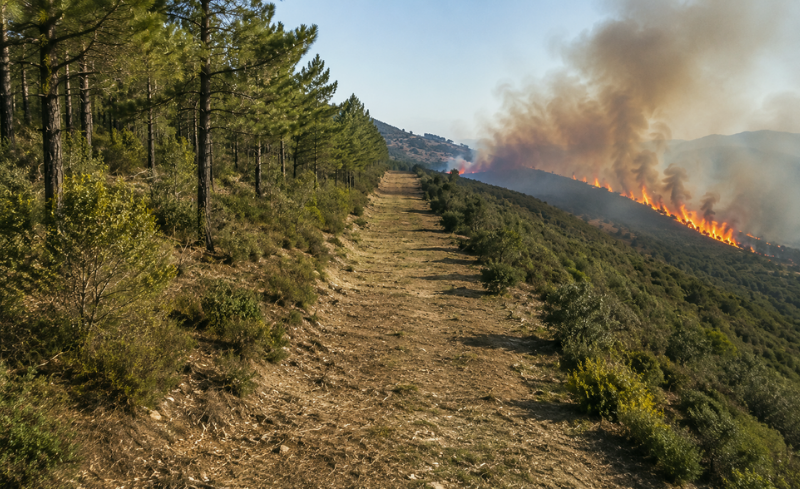
Every summer, the risk of forest fires once again becomes a major concern. High temperatures, drought, low humidity and strong winds can cause a small fire to spread rapidly and become difficult to control.
However, prevention does not begin or end with the arrival of summer. Maintaining plots, controlling vegetation, preserving protection strips and properly managing forest waste are all tasks that should form part of the regular maintenance of the land.
In areas where homes, residential developments, businesses and infrastructure are located close to woodland, this work becomes even more important. Excessively dense vegetation or the accumulation of dry material can encourage the spread of fire, while properly maintained land can facilitate access and the work of emergency services.
The risk does not start with the flames
A plot may appear quiet for much of the year, but vegetation continues to grow. Grass, shrubs, branches and other plant debris accumulate and, over time, can become a significant amount of fuel.
When does fire prevention really begin?
Long before flames appear, but also during the months when the risk is highest. Regular maintenance makes it possible to identify areas where vegetation has grown back, detect accumulations of dry material and address areas that could increase the risk.
The aim is not to leave the land completely free of vegetation. It is about managing it properly, reducing continuity and avoiding unnecessary accumulations of combustible material.
Protection strips: a key measure around homes and plots
In areas where homes are close to woodland, prevention becomes particularly important. These are known as wildland-urban interface areas, where homes, gardens, roads and forest vegetation coexist.
In these environments, protection strips play a fundamental role. Their purpose is to reduce the amount and continuity of vegetation around certain buildings and infrastructures, making it more difficult for a fire to reach them.
The characteristics and dimensions of these protection strips depend on the applicable regulations and the conditions of each site. For this reason, each area should be assessed individually.
Beyond meeting the relevant legal requirements, keeping these areas in good condition also facilitates access and the work of emergency services.
Clearing a plot is much more than cutting grass
When we talk about plot clearing, it is common to think only about cutting vegetation. However, effective forest fire prevention requires a broader approach.
It is necessary to assess how vegetation is distributed, which trees require maintenance, where debris accumulates and the condition of roads and access routes.
Three types of work are often part of the same maintenance plan: vegetation clearing, pruning and forest thinning.
 What is the difference between them?
 What is the difference between them?
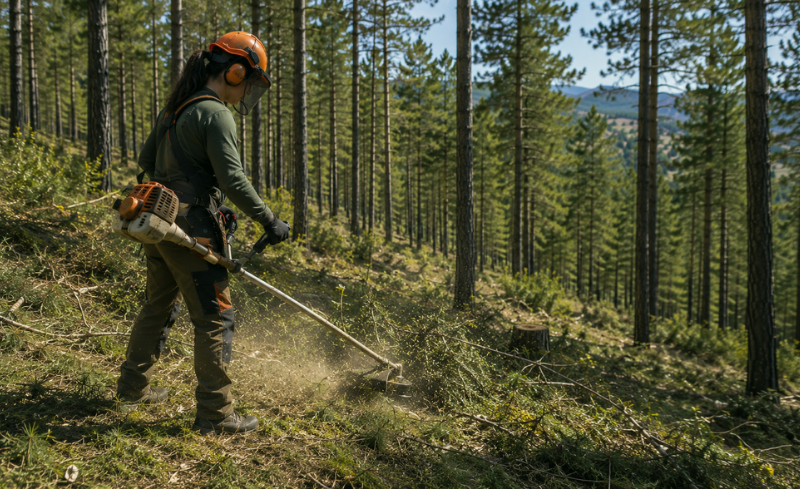
Clearing mainly focuses on low vegetation. It helps control grass, shrubs and other elements that can create a continuous layer of fuel across the ground.
Pruning focuses on trees and can help remove certain low or dry branches that encourage continuity between ground vegetation and the tree canopy.
Forest thinning, meanwhile, addresses tree density. When trees grow too close together, competition for water, light and nutrients increases, and fuel continuity between tree canopies can also become greater.
Each type of work has a different purpose, but they can complement one another to achieve more comprehensive land management.
Forest fire prevention is practical, on-the-ground work. Machinery and tools are important, but so is knowing which vegetation should be removed, what should be preserved and how to intervene without unnecessarily affecting the surrounding environment.
Does all vegetation need to be removed to prevent a fire?
No. And this is an important point.
A forest needs vegetation to maintain its balance. The aim of responsible forest management is not to remove it indiscriminately, but to achieve a more balanced structure and reduce those elements that can increase fire risk.
Selective clearing can control certain areas of shrubs or dry vegetation without removing all ground cover. Similarly, pruning and thinning should take into account the species, the condition of the trees, the density of the area and the characteristics of the surrounding environment.
Fire prevention and nature conservation can go hand in hand when work is carried out using appropriate technical criteria.
Vegetation is not the only source of fuel
After clearing, pruning or thinning, another element also requires attention: plant debris.
Branches, leaves, logs, shrubs and other materials removed during the work should not be left to accumulate without control. An intervention intended to reduce risk can lose some of its effectiveness if the resulting material is left in large piles of dry vegetation.
That is why managing this material is an integral part of forest maintenance work.
What happens to the debris after clearing or pruning?
 What happens to the debris after clearing or pruning?
Depending on the site, the volume and the type of material, there are different options.
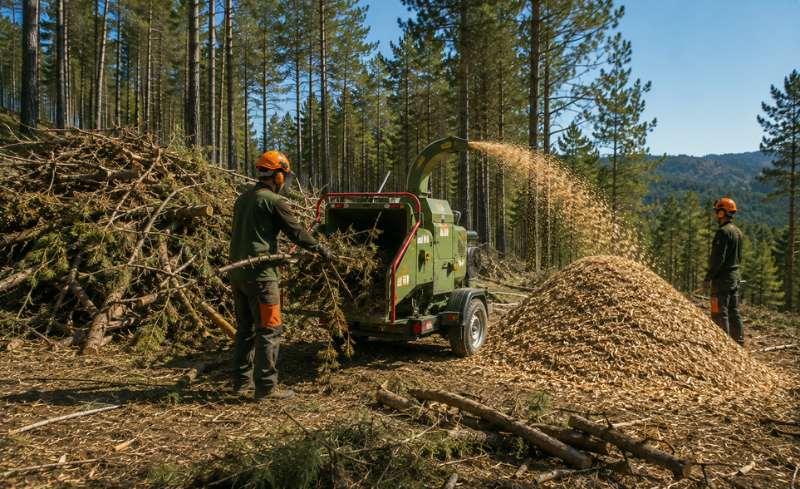
One of the most common is on-site shredding of plant material, which significantly reduces its volume and facilitates subsequent management. Where conditions allow, shredded material can remain on the land, where it can become part of the organic matter in the soil or be used as mulch.
In other cases, the material can be removed and transported for recovery, for example as biomass, always in accordance with the applicable requirements and regulations.
This part of the process is important because prevention does not end when vegetation is cut. It is also necessary to decide what to do with all the material that has been generated.
From waste to resource: making use of forest biomass
Material generated by certain forestry operations can be turned into a resource.
Forest biomass makes it possible to reuse material from pruning, clearing and thinning and give it a new purpose. This recovery process helps reduce the amount of waste left on the land and supports a more circular approach to land management.
In addition, properly shredding and making use of this material can prevent accumulations that, during dry periods, could once again become a source of fuel.
Not all material has the same destination. The appropriate treatment will depend on the material generated, the characteristics of the work and the applicable regulations.
Prevention also means monitoring
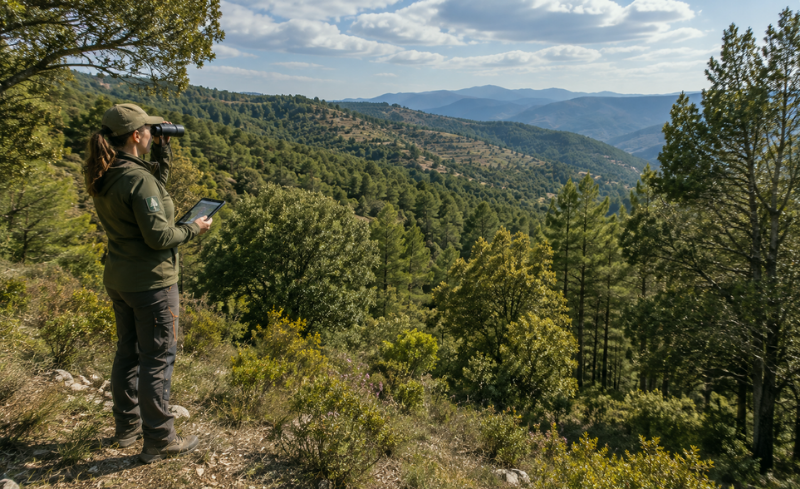 Prevention also means monitoring
There is an aspect of prevention that may be less visible than clearing or pruning, but is equally important: monitoring.
During periods of high fire risk, monitoring the condition of the land makes it possible to identify potential incidents and respond more quickly.
Monitoring from elevated points also provides a broader view of the surrounding area and makes it possible to check the condition of different zones.
Prevention therefore combines different tasks: managing vegetation, handling plant debris and maintaining monitoring systems that allow any unusual situation to be detected quickly.
Why can wind change everything?
During a forest fire, weather conditions can change the situation very quickly. Wind can accelerate the spread of flames and carry embers towards areas far from the main fire front.
That is why reducing vegetation continuity is particularly important. Land with a more controlled vegetation structure may offer less continuous fuel than an area where shrubs, dry branches and trees are excessively close together.
Prevention cannot control the weather, but it can address part of the fuel that feeds a fire.
Climate change: an increasingly important challenge
Forest management must also be understood within a changing climate.
Periods of drought, high temperatures and extreme heat events can increase vegetation stress and create drier conditions.
This does not mean that every forest fire can be prevented through forestry work. It means that maintaining the land in good condition is becoming increasingly important.
A properly managed forest can have a more balanced structure and less continuous fuel. In areas close to homes, appropriate management of the surrounding land can also help reduce the exposure of buildings.
Fire prevention and biodiversity: finding the balance
Managing a forest does not mean turning it into an empty landscape.
Vegetation plays an essential role for wildlife, soil and the ecosystem itself. For this reason, forestry work should be carried out selectively and with the characteristics of each area in mind.
Removing excessive vegetation, controlling invasive species and improving tree structure can all form part of a management strategy that combines both prevention and conservation.
The aim is to create a more resilient and better-prepared environment, not simply an area with less vegetation.
And after clearing, when should it be done again?
This is one of the most common questions when it comes to plot maintenance.
The answer depends on the vegetation, the size and location of the plot and the conditions of each site. A plot cleared today will naturally experience new vegetation growth over time.
For this reason, prevention should not be viewed as a one-off cleaning operation. The most effective approach is to establish a regular maintenance plan, assess the condition of the plot and schedule work according to its actual needs.
For homeowners’ associations, residential developments, businesses or public authorities, this type of planning makes it possible to organise the work effectively and avoid having all the necessary interventions concentrated at a single point in time.
Roads and access routes matter too
There is another element that deserves attention: roads and access routes.
A forest road with vegetation growing into the sides, branches obstructing passage or accumulated debris can make it more difficult for emergency teams to reach the area.
Keeping access routes clear improves accessibility and helps ensure suitable conditions should an emergency intervention be required.
For this reason, when planning the maintenance of a forested area, it is important not to focus solely on trees and shrubs. Access routes are also part of fire prevention.
Prevention is a year-round task
The arrival of the months with the highest fire risk does not mean that prevention stops. On the contrary, during summer, maintenance and monitoring remain essential to identify new vegetation growth, maintain protection areas and keep access routes in good condition.
At the same time, clearing, pruning, thinning and debris management require planning that goes far beyond a specific season.
Every site has its own needs. A plot close to a home does not have the same requirements as a forest area, just as a residential development requires different maintenance from a rural access road.
That is why effective prevention begins by understanding the site and determining exactly what it needs.
Espais Verds del Vallès: forestry prevention and land management on the ground
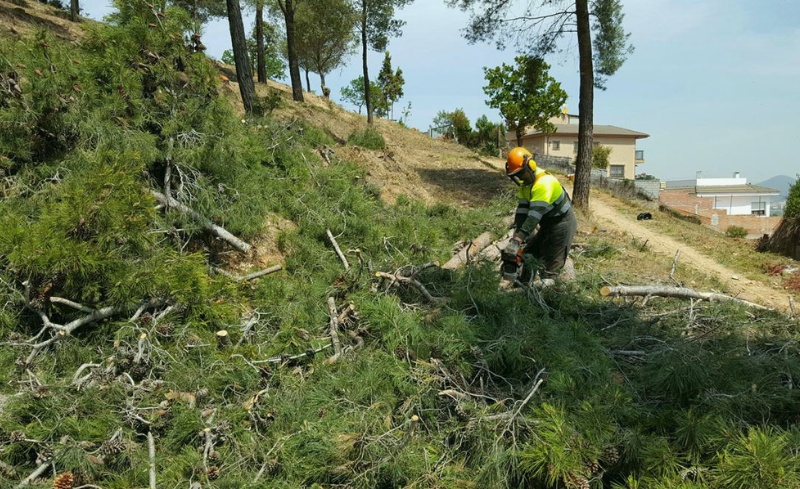 Espais Verds del Vallès: forestry prevention and land management on the ground
At Espais Verds del Vallès, we work on the maintenance and management of forest areas, plots and green spaces, carrying out work aimed at improving safety and preserving the surrounding environment.
Clearing, pruning, thinning, shredding and the management of plant debris are among the services that may be required to keep an area in good condition.
On-the-ground experience is essential. It is not simply about using machinery or removing vegetation, but about knowing what needs to be done, where it needs to be done and how to do it to achieve an effective result while respecting the environment.
In this case, we recommend replacing the current fire-prevention truck photograph if it is not a corporate image of TMA. As it appears at the end of the article, this image can help reinforce the company’s identity.
Ideally, it would be a company photograph showing the TMA team at work, company machinery during clearing or shredding operations, staff wearing appropriate personal protective equipment, or a completed project in a plot or forested area.
Prevention means working throughout the year
A forest fire can start within minutes, but prevention requires planning and continuous work.
Inspecting a plot, controlling vegetation, maintaining a protection strip, pruning certain trees, carrying out thinning, managing plant debris or keeping an access road clear are all measures that help prepare and protect the land.
Prevention also remains essential during the months of highest fire risk. Keeping areas under control and monitoring the surroundings makes it possible to identify new problems and act before they become more serious.
At Espais Verds del Vallès, we work to make prevention part of the regular maintenance of plots, residential developments and forest environments, combining experience, safety and care for the land.
Because forest fire prevention is not a one-off action: it is a way of keeping the environment prepared throughout the year.
We care for our clients.
We care for the environment.
If you would like more information about our services or have any questions, please don’t hesitate to contact us at espaisverds@tma.es.
¡At Espais Verds del Vallès, we work for a greener, safer, and more sustainable future for all!
Discover our comprehensive Gardening.
Follow us on TMA’s LinkedIn. Subscribe to our YouTube channel.
Contact us, we will be happy to advise and inform you.