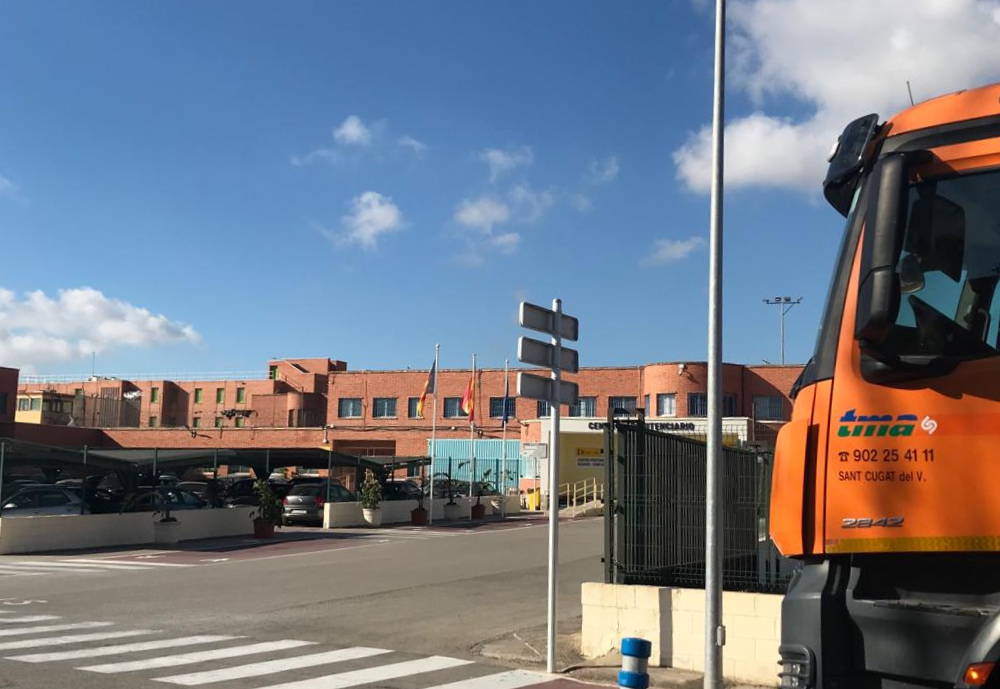

Waste management in facilities with high operational complexity, such as a penitentiary center, requires a combination of technical rigor and logistical capacity.
TMA is the company awarded the contract for the collection, transport, and management of municipal solid waste and organic waste at the Valencia Penitentiary Center Antoni Asunción Hernández.
This project represents a further step in consolidating TMA’s position as a leader in the Valencian Community in integrated waste management, sustainability, operational efficiency, and environmental compliance.
At the same time, it reinforces TMA’s role as a company specializing in advanced waste management solutions in sensitive environments, where service continuity, security, and traceability are essential factors.
WASTE MANAGEMENT IN PENITENTIARY CENTERS: OPERATIONAL AND ENVIRONMENTAL CHALLENGES

A penitentiary center is, in operational terms, a small city.
The Antoni Asunción Hernández Penitentiary Center in Valencia houses an average of over 2,200 inmates, distributed across two separate units (Serving and Pretrial Detention), each with its own kitchen.
In this context, the volume of waste generated is high, constant, and has specific characteristics.
Estimated production reaches approximately 108,000 kg of waste per month, necessitating the design of a highly efficient, safe, and perfectly coordinated collection and transport system.
Factors influencing waste management in a penitentiary
Unlike other institutional or urban environments, a penitentiary center presents critical characteristics:
-
- Controlled access and strict security protocols.
- Fixed schedules coordinated with internal operations.
- Generation of organic waste with a high liquid content.
- Need for uninterrupted service.
- Logistical limitations within the facility.
In this scenario, waste management is not just a service: it is a critical activity for the safety, hygiene and operation of the center.
QUALITY GUARANTEE IN WASTE MANAGEMENT IN PRISONS
TMA guarantees a service based on operational excellence and regulatory compliance.
Main guarantees of the waste management service
-
- Quality and professionalism: service performed by qualified personnel and following defined protocols.
- Schedule compliance: collections on the days and times established by the prison.
- Operational continuity: two self-compacting trucks always in operation.
- Comprehensive maintenance: regular inspection, cleaning, and disinfection.
- Incident response: equipment replacement in the shortest possible time.
- Responsible environmental management: transport to authorized facilities.
- Complete document traceability: control and justification of waste treatment.
- Continuous communication with the prison: proactive incident management.
This approach ensures a stable, safe service that complies with current waste regulations.
WASTE TYPES AT THE VALENCIA PENITENTIARY CENTER
The service provided by TMA covers the management of two main types of waste:
-
- Municipal solid waste from the residential modules.
- Organic waste from the center’s two kitchens.
OWN FLEET AND EQUIPMENT FOR WASTE MANAGEMENT
TMA has its own fleet and specialized technical equipment that allows it to provide waste collection and transport services efficiently, safely, and in accordance with current regulations.
The availability of its own resources not only guarantees continuity of service but also allows for a greater capacity to respond to incidents, optimizing response times and ensuring compliance with the required service levels.
In the case of the Valencia Penitentiary Center Antoni Asunción Hernández, both units (Compliance and Pretrial Detention) require independent teams due to their autonomous operation and the presence of their own kitchens in each unit.
This configuration significantly increases the generation of organic waste with liquid content, requiring specific technical solutions for collection, storage, and transport.
Material resources required for service provision
TMA must provide all the necessary material resources to perform the service with full operational guarantees, including:
-
- Machinery and vehicles authorized for waste transport, compliant with current environmental regulations.
- Tools and auxiliary mechanical equipment for handling and cleaning.
- Personal protective equipment (PPE) to ensure personnel safety.
- Approved cleaning and disinfection products suitable for waste management environments.
- 20 m³ self-compacting truck.
SELF-COMPACTING TRAILERS FOR WASTE MANAGEMENT: TECHNOLOGY AND OPERATIONAL EFFICIENCY
One of the key elements of the service is the installation of two 18–20 m³ self-compacting trailers, one for each unit of the Penitentiary Center (Sentencing and Pretrial Detention).
These self-compacting trailers are an essential component of daily operations, as they allow for the efficient management of both municipal solid waste and organic waste generated in the center’s kitchens.
Functions of the self-compacting trailers in waste management
-
- Waste compaction to optimize volume and reduce transport frequency.
- Safe and airtight storage, preventing leaks or spills.
- Odor reduction and minimization of health risks.
- Improved logistical efficiency in collection and transport.
Technical characteristics of self-compacting waste trucks

To ensure proper operation in an environment like a prison, self-compacting waste trucks must meet a series of key technical requirements:
-
- Leachate evacuation system with a drain tap, essential for managing organic waste with liquid content.
- High watertightness and structural resistance, preventing leaks and guaranteeing safety.
- Sufficient capacity for the efficient compaction of waste generated in both units.
- Compatibility with authorized transport systems and exchange procedures.
- Design focused on minimizing odors, spills, and environmental risks.
Importance of self-compacting waste trucks in waste management
The correct selection, installation, and maintenance of self-compacting waste trucks is crucial for:
-
- Ensuring uninterrupted service continuity.
- Preventing operational incidents within the facility.
- Preventing health and environmental risks.
- Optimizing logistical and economic resources.
In this sense, self-compacting machines are not just a technical element, but a key component in the overall efficiency of the waste management system.
Maintenance, cleaning, and disinfection of self-compacting machines: a guarantee of health and operational safety
Professional waste management in a complex environment such as a prison requires that self-compacting machines always operate in optimal condition.
Therefore, very specific obligations are established regarding their maintenance, cleaning, and disinfection, guaranteeing safety, hygiene, and operational continuity.
The correct functioning of self-compacting machines is fundamental to avoiding environmental and health risks.
Preventive and corrective maintenance
Includes:
-
-
- Periodic technical inspections.
- Checking of hydraulic and mechanical systems.
- Verification of the leachate drainage system.
- Preventive replacement of components.
-
Monthly cleaning and disinfection
Each self-compacting machine undergoes cleaning and disinfection processes with approved products, guaranteeing:
-
-
- Elimination of bacteria and fungi.
- Odor control.
- Optimal hygiene conditions.
-
This process is key to preventing health risks and ensuring a clean and safe environment.
Breakdown management and service continuity
If a self-compacting compactor breaks down:
-
-
- It must be repaired as quickly as possible.
- If it cannot be repaired, it must be replaced within 24 hours with another of the same specifications and capacity.
-
The goal is to ensure uninterrupted service by always maintaining two operational self-compacting compactors at the facility.
WASTE MANAGEMENT SERVICE: CONTINUITY, SAFETY, AND EFFICIENCY AT THE PRISON
The service awarded to TMA covers all phases of waste management: collection, transport, equipment maintenance, and final disposal at authorized facilities.
Each of these phases is defined by rigorous operating procedures, designed to guarantee service continuity, the safety of the prison environment, and regulatory compliance at all times.
Waste collection at the prison
Waste collection takes place within the prison itself, which necessitates coordinating each operation with established security protocols.
TMA personnel access the prison by strictly adhering to identification, authorization, and access control requirements.
Once inside, a carefully structured operating procedure is executed:
-
- Exchange of a full self-compacting truck for an empty one at a single vehicle entrance, optimizing time and reducing disruptions.
- Immediate cleaning of the surrounding area, collecting any waste that may fall during loading or handling.
- Leachate drainage, when necessary, before equipment removal, preventing spills and ensuring adequate hygienic conditions.
This procedure allows for waste collection with the highest level of order, cleanliness, and efficiency, without affecting the center’s internal operations.
Waste transport to authorized facilities
Once removed, the self-compacting unit is transported by authorized vehicles to duly accredited treatment or disposal facilities.
During this phase, the following is guaranteed:
-
- Compliance with regulations regarding waste transport.
- Complete traceability of the waste from its origin to its final destination.
- Prevention of environmental risks during transport.
Upon arrival at the authorized facility, a complete technical process is carried out:
-
- New leachate drainage at specifically designated points.
- Complete emptying of the self-compacting unit.
- Comprehensive cleaning and disinfection of the equipment before reuse.
This continuous cycle allows the self-compacting machines to be maintained in optimal condition and ensures the proper environmental management of waste.
Regulatory compliance in waste management
Regulatory compliance is one of the fundamental pillars of the service.
TMA integrates this legal framework into all its operating procedures, guaranteeing:
-
- Complete document traceability at all stages of the process.
- Waste transport using authorized and registered vehicles.
- Final management at legally accredited facilities.
- Prevention of environmental risks arising from spills or leaks.
- Proper declaration and notification of waste to the competent authority.
Regulatory compliance is not limited to a legal obligation, but is part of TMA’s commitment to sustainability, environmental responsibility, and excellence in service delivery.
IMPORTANCE OF SERVICE CONTINUITY IN WASTE MANAGEMENT

In a prison, waste management cannot fail.
An interruption of service could lead to:
-
- Hygiene problems.
- Health risks.
- Accumulation of waste in sensitive areas.
- Internal operational incidents.
Therefore, TMA will provide waste management services guaranteeing:
-
- 24/7 availability of a technical manager.
- Immediate replacement of broken-down self-compacting machines.
- Capacity to carry out extraordinary collections, if the volume of waste requires it.
TMA brings its experience in essential services, guaranteeing stable, safe operations adapted to the actual needs of the facility.
TMA: SPECIALIZED WASTE MANAGEMENT COMPANY IN VALENCIA
The awarding of this contract reinforces TMA’s position as a leading waste management company in the Valencian Community.
Its value proposition is based on a combination of key factors:
-
- Technical capacity, with modern, efficient machinery adapted to the needs of each service.
- Operational experience, especially in complex and demanding environments.
- Environmental commitment, aligned with current regulations and sustainability objectives.
- Professionalism of the team, trained, qualified, and focused on service excellence.
This combination allows TMA to handle highly complex projects with confidence, providing effective solutions tailored to each environment.
TMA doesn’t just provide a service: it offers peace of mind, operational continuity, and a guarantee of compliance.
WASTE MANAGEMENT IN PRISONS: KEY TO SAFETY, HYGIENE, AND SUSTAINABILITY
Waste management in a prison is an essential service that requires precision, continuity, and a high level of responsibility.
The awarding of the service contract at the Antoni Asunción Hernández Prison in Valencia demonstrates the confidence placed in TMA as a company capable of guaranteeing:
-
- Safe operations, adapted to an environment with high control requirements.
- Environmentally responsible management, in accordance with current regulations.
- Strict regulatory compliance in all phases of the service.
- Continuous maintenance and permanent availability of equipment.
- Professionalism and technical rigor in every intervention.
Beyond the provision of the service, this project reflects TMA’s commitment to efficient, sustainable waste management focused on continuous improvement.
This is an essential task that contributes not only to the proper functioning of the prison but also to the well-being of its people and the protection of the environment.
At TMA we believe that sustainability begins with every service we provide, even those that, although less visible, are essential for the functioning of society.
If you need efficient waste management, tailored to your business and aligned with your 2026 environmental goals, we would be delighted to help.
Write to us at comercial@tma.es and we will prepare a personalized proposal for you.
Discover our comprehensive waste management services and join us on the path to a more sustainable future.
We take care of our customers and we take care of the environment.
We are much more than comprehensive waste management.
Follow us on TMA’s LinkedIn. Subscribe to our YouTube channel.
Contact us, we will be happy to advise and inform you.